
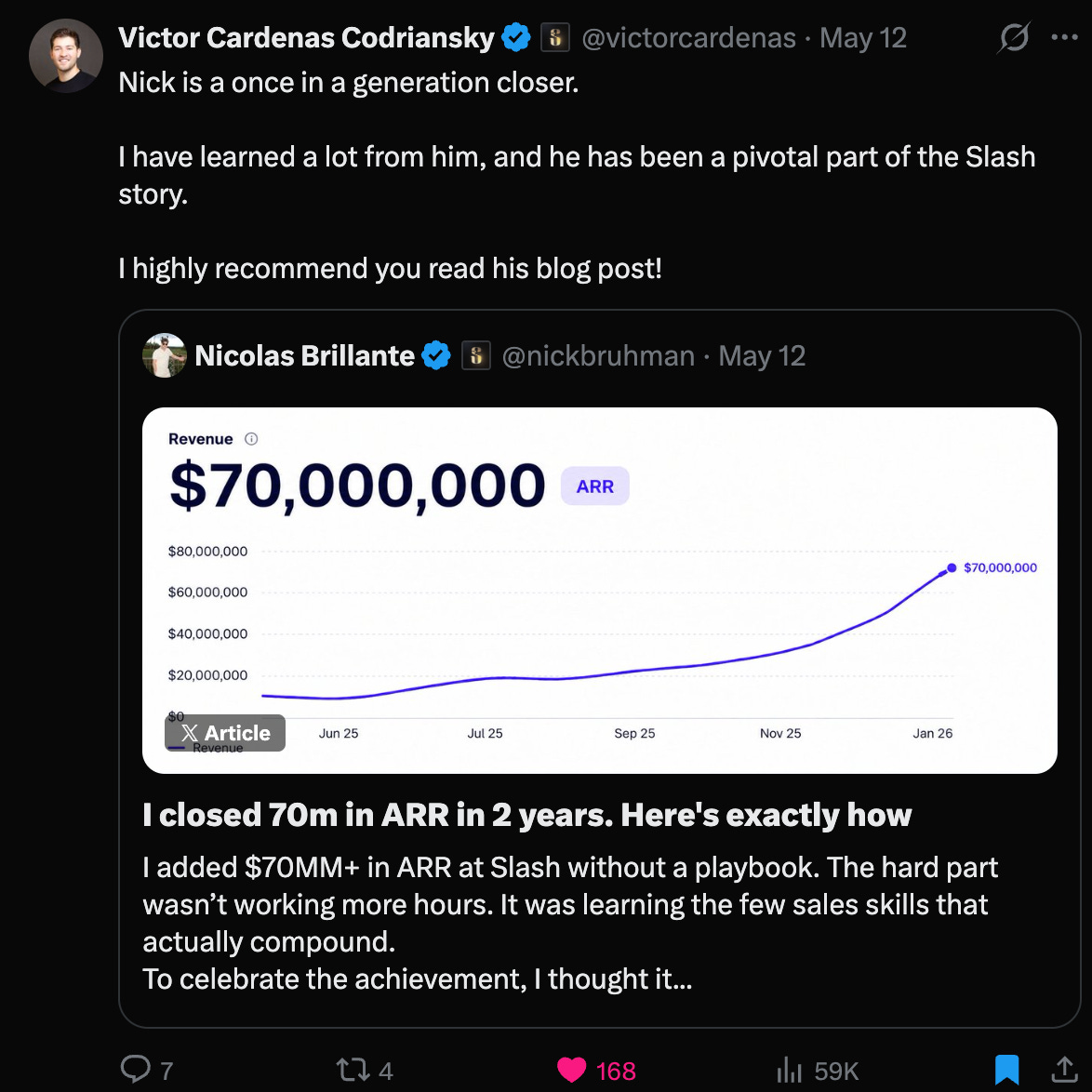
I closed $100M+ in ARR in 28 months. Every day, I close over $1M. That’s more than most sales teams do in an entire quarter. It’s not because I have a superpower or crazy inbound. It’s because I understand a few cheat codes 99% of salespeople don’t.
If you work in sales, GTM, or if you run a business, this might be the most valuable thing you read all day. My only ask is that if you find it valuable, leave a comment and share it with someone else who will too. And if you’re looking for a better banking platform, reach out and let’s get you onto Slash.
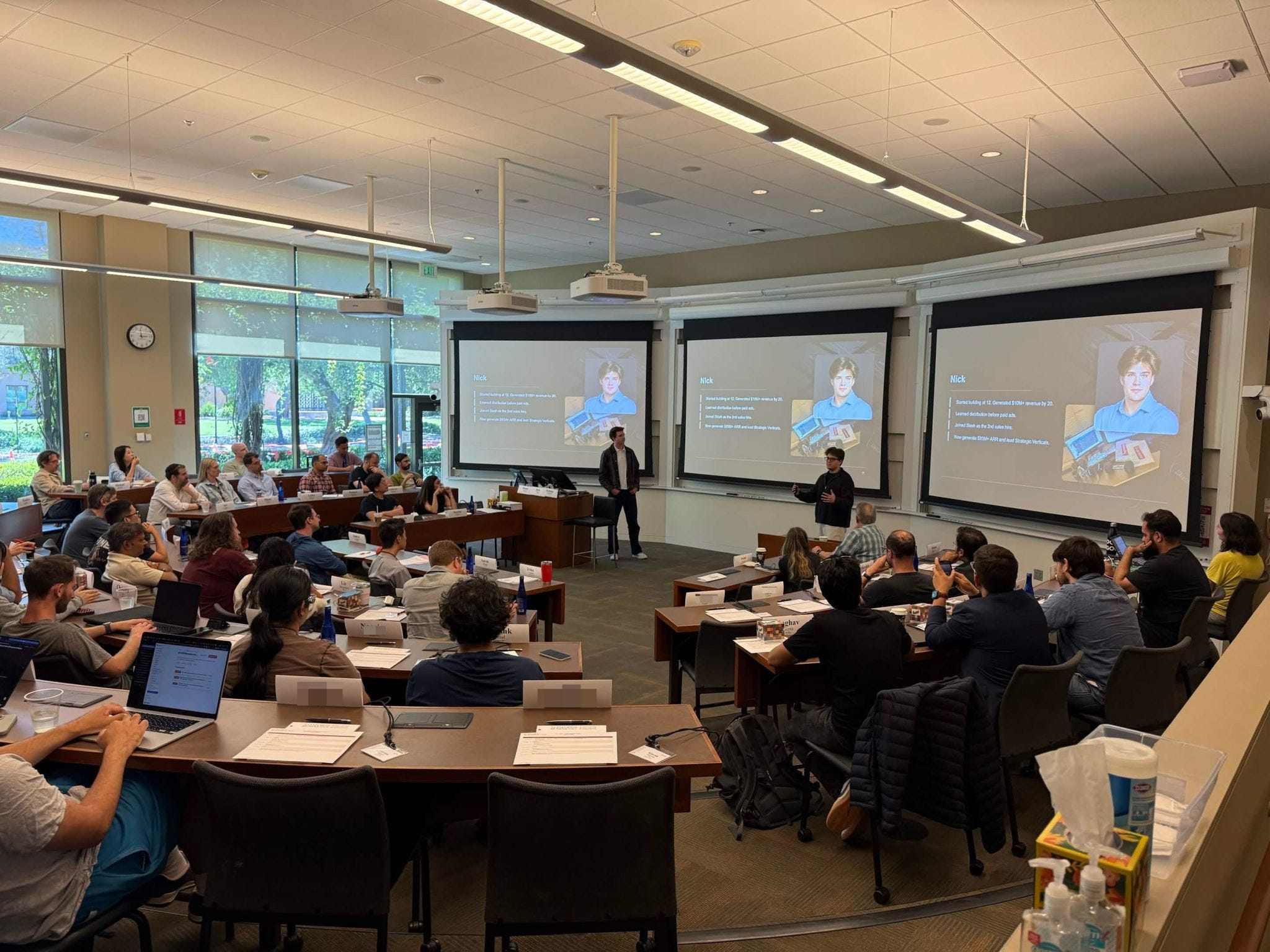
I closed my first $1M at 21. Before Slash, I ran six businesses that did over $10M in revenue. Since then, $10B+ in TPV and more than $300M in AUM. Here’s my playbook.
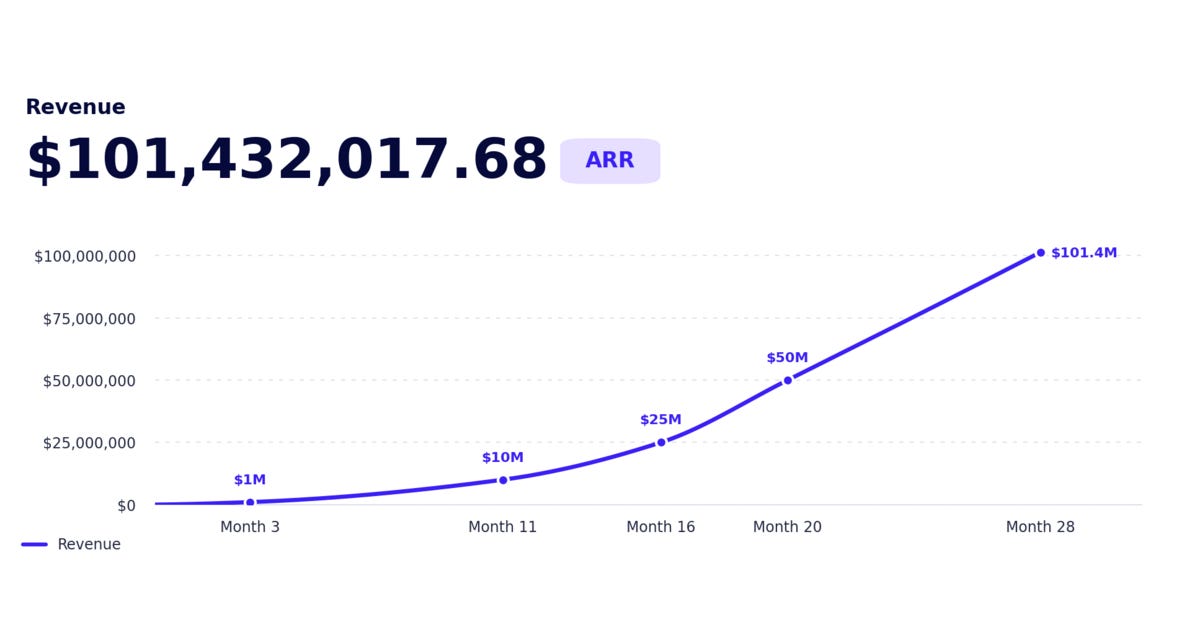
$0 to $1M: Three Months, 100 Accounts, One Excel Spreadsheet
The first $1M took three months. Around 100 accounts onboarded, my biggest doing $1M a month in card spend, and the entire sales team was four people: me, Oscar, our CRO Shaan, and our CEO Victor. I tracked every lead in an Excel spreadsheet.
For me, getting off the ground from zero required becoming an active, engaged member of the communities I was a part of, and seeing where in those communities there was opportunity.
Before I was at Slash, I was a member of the online sneaker resale community. It was that connection that got me to Slash in the first place, and instead of treating my new job as a departure from that world, I went back to what I knew.
I went looking for people posting about how much inventory they were buying. If you’re bragging about inventory volume, that means you’re already spending serious money. I DM’d a reselling business that was doing $50k a month in card spend. It closed two weeks into the job. I was so excited – I told everyone I knew.
That deal had nothing to do with a demo. Before the call, I learned everything I could about their current setup and found a real problem: their rep gave them horrible customer support. So I gave them my personal phone number and promised them a seamless onboarding experience. That was the entire pitch.
After that deal, I made a mistake: I switched my strategy too early. Leverage your network before you touch cold, wherever you’re selling. Going in cold is very, very hard. I know because I spent the next few months doing exactly that.
I went hunting for leads on Reddit, Facebook, X, Discord, forums, anywhere businesses talk to each other. Hundreds of emails a day, as many calls as I could physically take.
My opening line was: “Hey, I’m working at an up & coming banking platform, and I’d love to hop on a call with you to see how we can benefit your business.”
The problem was never that people didn’t understand what a neobank was. I was competing against Mercury, Ramp, Brex, and every regional bank out there; most businesses I talked to already had something that worked fine.
Even if I got through the neobank explanation, nobody had heard of Slash. The first call was almost never a sales call – it was me explaining who we were and why their business should trust us with their money.
I never used a script, but that doesn’t mean I walked in blind. On every call I figure out four things:
How big a client they actually are
How big their network is
Which communities they live in
Whether they’re open to adding something new to the stack.
Everything else I make up as I go, because every lead is different: it could be a different personality, different business, or a different stage of life. The best skill in sales is molding yourself to your lead; that’s how you become instantly likable to whoever is in front of you.

Dig Yourself Out or Stay in the Hole
For the first month I thought I was going to get fired. We had no onboarding system for new employees: you got thrown in a hole, and it was up to you to dig yourself out or stay in it.
What got me out wasn’t learning how to sell. It was realizing I already knew how.
I’d been running my own businesses for a decade, and I treated Slash exactly the way I treated them: the same level of support, the same obsession with being reachable, the same instinct for finding an edge and getting something shipped before anyone else could. When you’ve run a business yourself, you learn that the speed of your offer beats the quality of someone else’s offer more often than it should.
The habits came with me too. Persistence, discipline, showing up every single day, being better than I was the day before, and giving up a lot of my life so clients could always reach me. I didn’t build any of that at Slash. I brought it in the door with me.
I also couldn’t have asked for a better team to start with. I learned so much from Victor, Shaan, and Oscar, and they pushed me way past what I thought my limits were. They built me into the person I am today, and I genuinely don’t think I would’ve added the next $99M without them.
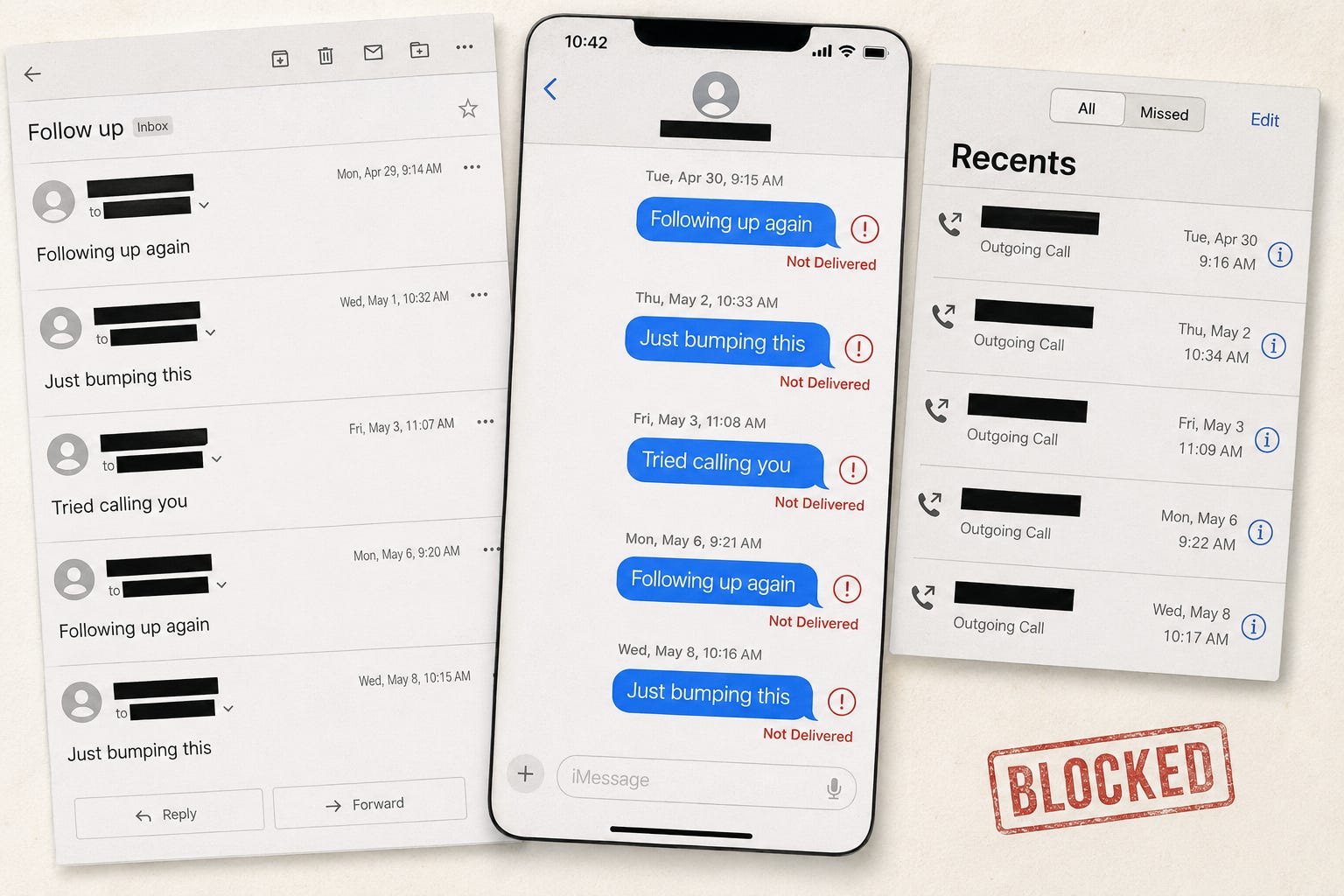
Still, there were setbacks. That year, I lost a client doing $3M a month in card spend. I did everything I could to make it work: I followed up every few hours over email, then text, then call.He ended up blocking me on all three.
Anyone can be annoyed into responding. People are far more alike than they want to admit, so either you onboard the lead or you get blocked. There’s no in between, and I’d rather find out which.
There were plenty of weeks where I closed nothing. I used that time to find new niches and verticals, and I asked my existing clients as many questions as I could to get introduced to worlds I didn’t know existed. Nothing dramatic broke the streak; I just kept showing up.
At $0, I thought this would be hard. It isn’t hard; it’s scary. You have no clue where your next big lead is coming from or when. The only thing that keeps your mood up is believing it’ll get better soon, and I was never willing to quit.
$1M to $10M: Eight Months, and Never Disqualify on Volume
Nobody trusted us yet, so a cycle for someone spending $10k a month could take weeks when it should’ve taken hours. Six-figure accounts were out there, but waiting for more of them to show up wasn’t a plan. If the market wasn’t going to move faster, I had to change what I was going after.
That forced the most valuable mindset shift I’ve had. I decided to treat every opportunity the same, regardless of how big the deal would be. The founder opening an account with $2,000 in it got the same onboarding call I’d give a company wiring seven figures.
Our competitors only chased six figures and up. I went the other way.
It looked inefficient for about a year. But we believed in the businesses we were onboarding, and did our best to support them on their journey. Over time, those accounts grew, and they started telling companies bigger than they were about us.
During this stretch, we were also selling a product that wasn’t ready.
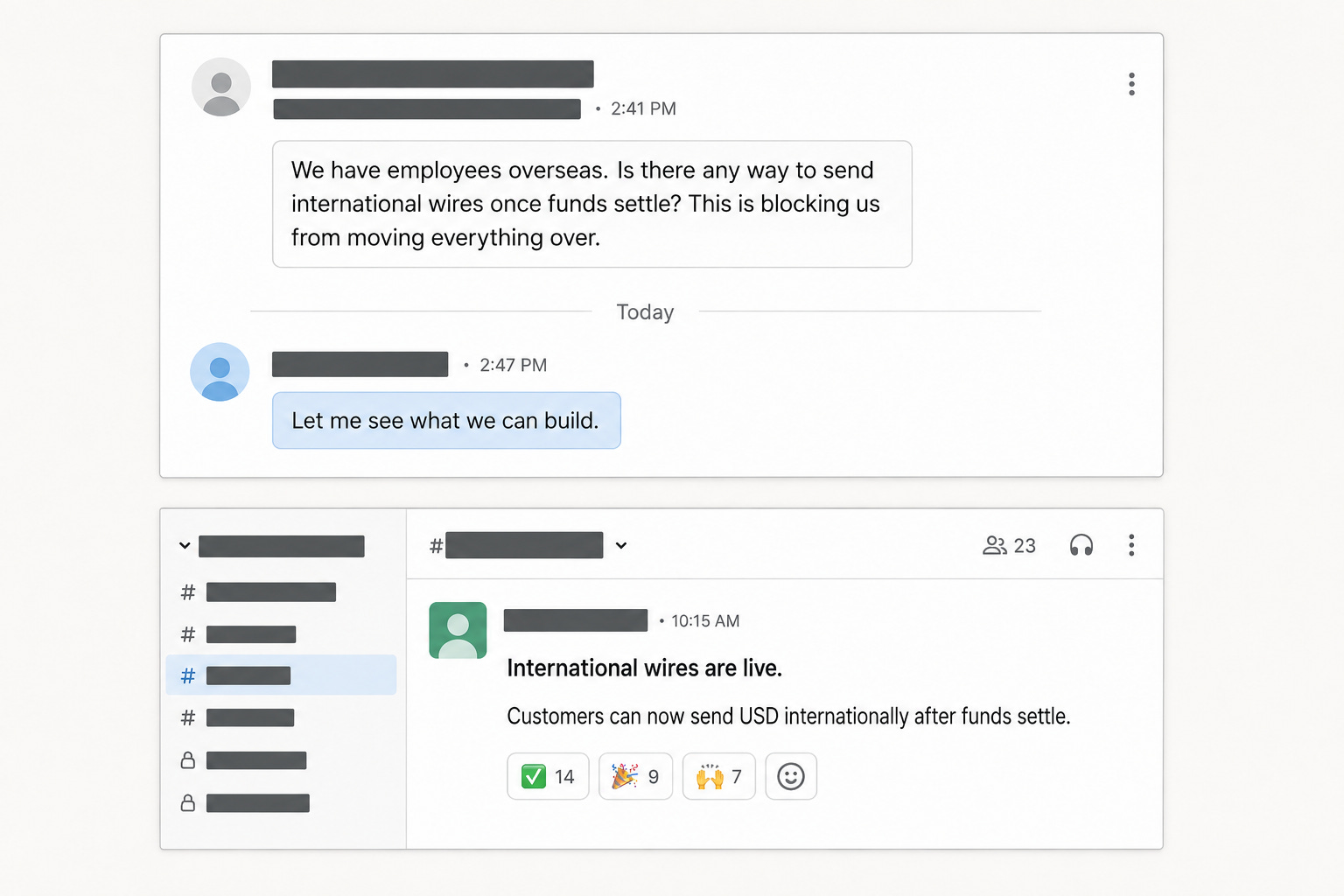
Slash was built for sneaker resellers, which meant we were missing many of the features businesses expected from a banking provider.. Back then, you couldn’t even send money internationally once funds settled, which killed deals outright.
Here’s how a startup with 20 people delivers more than a late-stage company with 1,000: when a customer needs something, we build it.
Within my first two months, I got engineering to ship international wires so we could support customers with foreign employees, and that’s when things really took off.
$10M to $25M: Five Months, and One Client Teaches You a Whole Industry
With five people on the sales team, going one customer at a time was never going to get us where we wanted to be. So, I stopped hunting leads and started hunting verticals.
When you onboard a company, you get access to someone who knows every competitor, every supplier, every conference, and every reason their industry is underserved by its current bank. So I started asking questions.
I dug harder than anyone expected me to. Whenever I onboarded into a new industry, I gave myself a week to figure out everything about it: how the money moves, what the margins look like, what seasonality does to their cash, which regulations they’re scared of, who their competitors are.
A week sounds aggressive until you realize the alternative is spending a year half-understanding it.
Once you know an industry, you walk into the call already knowing the unit economics, the compliance headaches, and what their bank does badly. By the fifth company in a niche, you know their business better than the rep who’s been calling them for years. They can feel that in the first five minutes.
$25M to $50M: Four Months, and It Starts to Compound
This was the fastest stretch of the entire journey, and I want to be honest about why, because most people writing posts like this pretend it was uphill the whole way.
It gets easier. Not because you get better, although you do. It’s because you’ve accumulated proof: every logo, every dollar of deposits, every founder telling another founder. Around this point, I stopped having to explain who we were, and people started showing up asking how fast they could move. That’s a strange feeling when in your first year, every conversation began with “how the hell do you guys do banking? I’ve never heard of you.”
I’ll be honest: inbound almost never happened on its own. I chased introductions and cold leads for years. It’s only now, managing 3,000+ accounts, that a real volume of referrals comes to me, and it isn’t because of marketing. It’s because of how I manage those accounts and how often I get the features they need built.
Confidence carries you to this point. Someone once asked me how Slash could issue bank accounts without a charter license, and I had no clue, so I made up an answer on the spot that satisfied him. I’m not telling you to lie to customers. I’m telling you that confidence is the difference between losing a deal and keeping it alive long enough to get the real answer.

$50M to $100M: Eight Months, and the Job Changes
The reward for closing a great account is that you now have a great account to manage.
At $50M, I was still the point of contact for most of my accounts. I knew the spend patterns; I knew which founder texted at 11pm; I knew who wanted check-ins and who wanted to be left alone.
That worked until it didn’t. Slash could only have as many strategic accounts as I had hours.
A lot of this stretch was enterprise, and I’ll be honest, enterprise isn’t as fun. The cycles are long, the calls are full of people who aren’t the decision maker, and the energy is nothing like closing a founder who’s actually excited. But I’ve onboarded a ton of $1B+ companies onto Slash individually, without leaning on a whole enterprise team to do it.
The way out isn’t time management. I tried that. It’s separating the accounts that genuinely need me from the ones that only need me because I never trained anyone else to run them. Most of them were the second kind.

I Don’t Track My Own ARR Anymore
Here’s what I actually do now, and it’s the opposite of what got me here.
I give away every single inbound client that comes my way. In August alone, I handed out north of $20M a month in spend. I have no reason to keep adding to my own plate. The best thing I can do for the business is hire people like me, train them to operate like me, and hand them part of my book so they have something real to grow from.
That last part matters more than people think. You can’t hire someone, give them nothing, and expect them to build from zero the way you did when the company was four people. The conditions aren’t the same anymore. Giving away accounts I closed myself is the fastest way to get someone up to speed.
It also means I hire extremely carefully. I’m not willing to spend a million dollars worth of my time on training only to have to do it again a year later. I hire people I intend to keep forever.
What I look for hasn’t changed since I was the one getting hired:
High agency over everything. What I want is proof that someone did something hard without being told to, or someone who can point to a specific thing they built, sold, or fixed because it bothered them that it was broken. Most of the strongest people I’ve hired weren’t in the top seat at a name brand company. They were doing something slightly odd and doing it obsessively – that’s exactly what I was doing at 17.
Speed over polish. I’d rather have someone who stumbles through a call but sees where it’s going than someone smooth who can’t go off script. Delivery is trainable. Reading a room isn’t.
Comfort with no playbook. Our best people get handed something nobody has sold into and come back with a playbook. It’s the same hole I got thrown into.
Genuine curiosity about the customer’s business. Fintech isn’t a product sale, it’s a conversation about how money moves through the thing they built. If you aren’t actually interested, they can tell in four minutes.
On handing off an account: it isn’t enough to send an introduction email with the new guy CC’d. First, your new hire should sit in on your calls and say nothing. Then they should run the call and you sit in and say nothing. Eventually, they’ll be able to run it alone without you on the invite.
Anything faster and you’ll get pulled back in within a month. Worse, the customer learns the new person isn’t the real decision maker. The handoff is complete when the customer texts them instead of you.
Stay Close to the Product
The other half of my job now is product, and at this stage I don’t think that’s optional.
When you’re on the front lines, you know exactly what clients want (sometimes before they know it themselves). Stay in tune with that and you’ll find the best ideas in the strangest requests – things you never would have imagined mattering. Some of the most valuable things we’ve built came out of a throwaway complaint in the last two minutes of a call.
If you stop talking to the product team, you’ll eventually end up selling something that’s drifting away from the market you’re standing in.

What It Actually Costs
Here’s the part I’ve never told anyone. This isn’t for everyone.
I’ve been able to do this because I’ve given up almost everything else. No hobbies. No gym. I spend a quarter of every year traveling. I’ve been chronically online and working since I was 12. Most days, I work 15 hours, weekends included.
I’m not saying that to flex. Every post like this leaves it out, and then people read it and wonder why their version isn’t working. That’s the trade I made, and you should know it’s the trade before you decide you want this.
What makes it worth it is watching a business realize Slash is the banking experience they should have had from the start.

Advice, Depending on Where You Are
If you’re brand new in sales. Volume, always. You don’t have taste yet and you won’t get it by thinking about it. You’ll get it by hearing no a few hundred times and noticing which nos rhyme. Learn your customer’s business better than the last person who called them, and use your network before you touch cold.
If you’re at $50M. Your problem isn’t demand anymore, it’s you. Find every recurring commitment on your calendar that exists because you never trained a replacement, and start those handoffs while it still feels early. Every seller I hired felt slightly premature, and every one of them turned out to be slightly late.
If you’re about to cross $100M. Stop counting deals and start counting people who can close deals without you. The number that predicts your next year isn’t pipeline, it’s how many operators could run your book if you disappeared for a month.
If you’re joining a company like this one. Show up every day and learn from every person around you. The only reason we’re where we are is the team behind the product. Everyone at Slash is unbelievably cracked, and every person here had a successful business before they walked in. There’s a reason for that.

The version of me that couldn’t close anyone for weeks wouldn’t believe any of this. That guy thought the hard part was getting someone to say yes.
If any of this sounds like you, I’d love to have you on my strategic vertical team at Slash. There’s a reason we compete with banks ten times our size with a team under 100.
Fire